ezra@wonderrstudio.co.za | +27 71 865 2249

Animation and story-driven visuals aren't just for cartoons. They're one of the most powerful — and misunderstood — tools in a music artist's arsenal.
It is no mistake: when talking about Gorillaz, the rock and alternative community knows exactly who you're talking about. Having started their career in the late 1990s as arguably the first Western virtual band, they've made headway in ways few acts could have predicted.
Damon Albarn, the lead musician who started the project alongside Jamie Hewlett, a cartoonist, was tired of an industry obsessed with image and marketability. He wanted to expand into something that truly felt authentic and creative. And so Gorillaz was born — a project where music and visual art fused into a living world of experimentation.
"It was our way of satirising the pop movement, or the way pop was going, in a way of making it feel authentic. Within the DNA of Gorillaz, there's a lot of what popular culture is these days."
— Damon Albarn, - Rolling Stone UK (2025)
| 7M+ Debut album copies sold | 25+ Years active | #1 Guinness: most successful virtual band | 14M+ Views in 3 months (new short film) |
Look at them 20+ years later — and they haven't been forgotten. In February 2026, they released their ninth studio album, The Mountain, and made a massive impact once again. Their animated short film The Mountain, The Moon Cave & The Sad God went viral multiple times on social media, amassing 14 million views in just three months.
What makes this even more remarkable? The eight-minute hand-animated film, directed by Hewlett alongside studio The Line and produced over 18 months, was deliberately crafted using traditional hand-painted methods — a conscious pushback against the AI-generated content flooding the internet. As Jamie Hewlett put it, the creative team aimed to "reinterpret Gorillaz through the timeless aesthetic of 1960s animated features."
"If you have the ideas, then keep moving forward."
— Jamie Hewlett, co-founder of Gorillaz (Rolling Stone UK, 2025)
This is the argument most recording labels and indie artists reach for. "That's a cool idea and we'd love to do it, but we don't have the budget." And that argument is fair — animation can become expensive, and there's no way to talk around it. But so is cinematography and videography. Film-based productions require equipment, location fees, crew, and a long post-production pipeline too.
So let's break down the real numbers — because the gap between animation and live-action might surprise you.
| Film-shot MV (US, 3 min) Basic performance: $1,500–$4,000 Professional indie: $5,000–$10,000 Cinematic indie: $10,000–$25,000 Premium production: $25,000+ | Animated MV (US studio, 3 min) Motion graphics: $2,000–$5,000 Limited animation: $3,000–$8,000 2.5D character: $8,000–$20,000 Frame-by-frame: $20,000–$60,000 |
The pricing is comparable — and in many cases, animation offers a significant advantage: longevity. A great animated music video doesn't age the way a live-action video can. The characters, style, and world live on. Gorillaz's earliest animated videos from 2001 are still being watched and shared today.
Oh — and a "video" shot on your phone won't have the same effect, unless you know exactly how to manipulate it artistically to deliver the same impact that a proper music video does.
Because Wonderr Studio is based in South Africa, there's a meaningful currency advantage — you get the same level of creative work at more competitive pricing:
| Wonderr Studio · ZA Animation pricing (USD) Limited animation: $5,520–$9,200 2.5D character: $9,210–$15,350 Frame-by-frame: $18,420–$30,700 | What's included Script & concept Storyboarding Character design Animation + post |
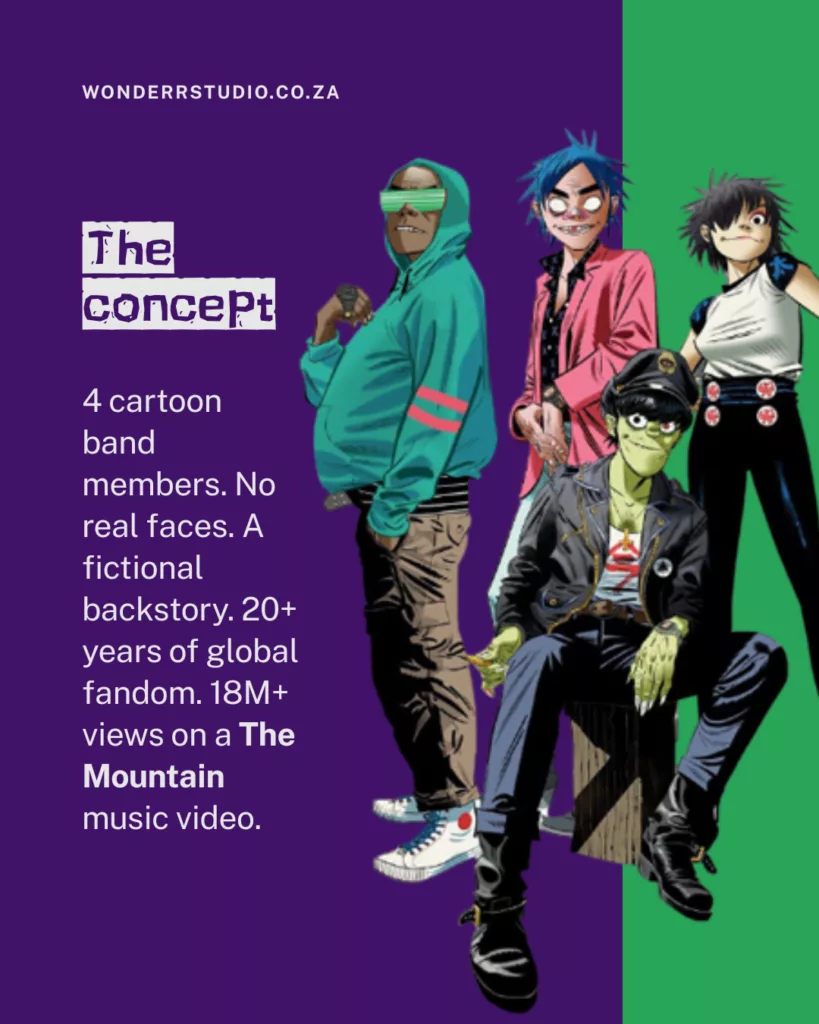
This is the benchmark. The gold standard. Gorillaz proved that animated characters can carry a fanbase for over two decades — across nine albums, world tours, exhibitions, and now a short film that trended globally. Their animated universe isn't just a music video strategy; it's a complete world that keeps fans coming back.
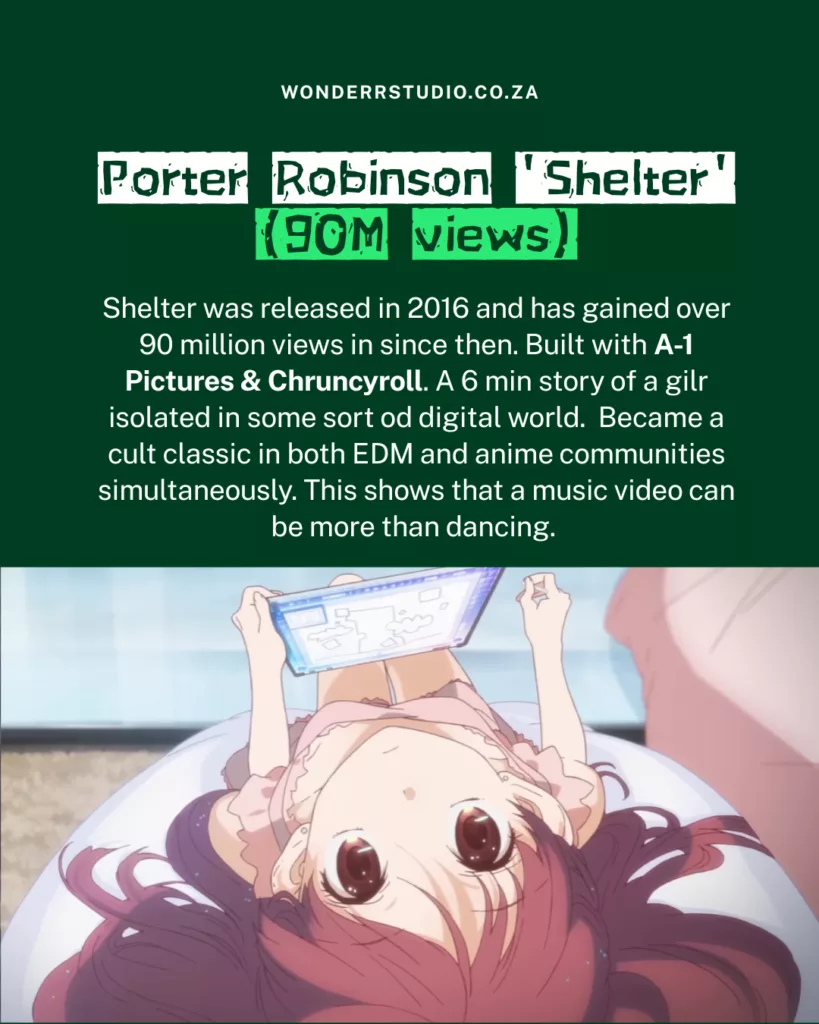
Created with Japanese anime studio A-1 Pictures, Shelter generated over 90 million views and simultaneously captured two entirely different fanbases — EDM enthusiasts and anime fans — through the power of story-first animation. The animation didn't just accompany the music. It told a story that made the music more meaningful. That's what separates a good music video from a cultural moment.
In a world flooded with unauthentic content, original story-driven animation is one of the most powerful ways to promote a song, build an artist's identity, and keep fans returning for more. Gorillaz didn't just release music — they built a world. That world is still growing.
Gorillaz is a virtual band formed in 1998 by Damon Albarn and Jamie Hewlett — widely recognised as the first successful Western virtual band. They hold a Guinness World Record as the "most successful virtual band" and have sold over 7 million copies of their debut album. Their model of fusing animation with music is a proven playbook for building a lasting artist identity.
In the US, both types of production sit in a similar price range. Live-action music videos range from $1,500 (basic) to $25,000+ (premium). Animated music videos range from $2,000 (motion graphics) to $60,000 (frame-by-frame). The key difference is that animation tends to have longer cultural shelf life — animated content rarely "dates" the way live-action footage can.
Yes — particularly story-driven animation. Case studies like Gorillaz and Porter Robinson's "Shelter" show that animation creates deeper emotional connections and can capture multiple audience segments simultaneously. The return on investment comes not just from initial views, but from the evergreen nature of animated content.
The main types are motion graphics (text and shape-based), limited animation (simplified character movement), 2.5D character animation (layered depth with character rigs), and frame-by-frame (traditional hand-drawn, like Gorillaz's latest short film). Each has a different price point and visual quality.
Studios based in South Africa can offer internationally competitive creative quality at lower USD price points due to the favourable exchange rate between the South African Rand and the US Dollar. This makes studios like Wonderr Studio an attractive option for international clients seeking high-quality animation at a reduced cost compared to US or European studios.
Gorillaz's 2026 short film The Mountain, The Moon Cave & The Sad God gained 14 million views in three months. Porter Robinson's "Shelter" exceeded 90 million views. Both demonstrate that story-driven animation can achieve significant organic reach across social platforms and fanbases.
Production time depends heavily on the style and scope. Motion graphics can be completed in 2–4 weeks. Limited animation typically takes 4–8 weeks. 2.5D character animation usually requires 8–14 weeks. Frame-by-frame projects, like Gorillaz's latest short film, can take 12–18 months for a high-detail, multi-song production.


